


The Retail Razor: Data Blades podcast cuts through the noise, turning complex retail research into actionable insights for AI-first strategies that optimize customer experiences and business operations.Stay Sharp. Be Data-Driven. Harness AI!
Missed the last issue?

It was the late 2000s. TVs up in the rafters, well above eye level, too small to read, playing audio that was losing a fight with Walmart Radio. I noticed because it was my job. I was leading product teams, delivering managed digital signage to retailers, and I would walk stores to look at the competition and how “they did it” thinking we could do better. What I didn’t know was that Mike Hiatt had moved his family from Salt Lake City to Bentonville on the promise that he’d get to tear it all out and start over. And so he did.
Pilots everywhere. Impact almost nowhere?
Two numbers landed about five minutes into this latest Data Blades podcast recording, and the rest of the conversation reorganized itself around them.
Boston Consulting Group looked at AI leaders in the last year and found 2x revenue growth on specific projects, with 40 to 50% cost reduction alongside it. McKinsey, later that same year, looked at organizations that had already adopted AI and found under 1% seeing enterprise-wide impact.
The pilots work. Yet, somehow, the enterprise stays exactly where it was.
Our guest for this episode, and the next two, is Professor Brett Duarte from Arizona State University’s W. P. Carey School of Business, where the supply chain program ranks #2 in the country. He teaches in the NASPO Department of Supply Chain Management, co-directs the business analytics program, and is assistant chair for graduate programs in supply chain. Casey’s response to that list of titles was an early highlight of the episode:
“It’s a good thing you’ve got lots of time on your hands.”
So yes, he is quite a busy academic. In fact, Brett is also on the faculty for ASU’s AI-Enabled Supply Chain Strategy executive program, that runs October 5 to 7 in the main Tempe campus. This series follows the program’s shape. Procurement today, operations next week, logistics the week after. For more details on the executive program, check out the callout block below. And if you listen to the full episode, you’ll get a discount code for $1,500 off the registration fee - just for our listeners!
SPONSOR: ASU W.P. Carey School of Business
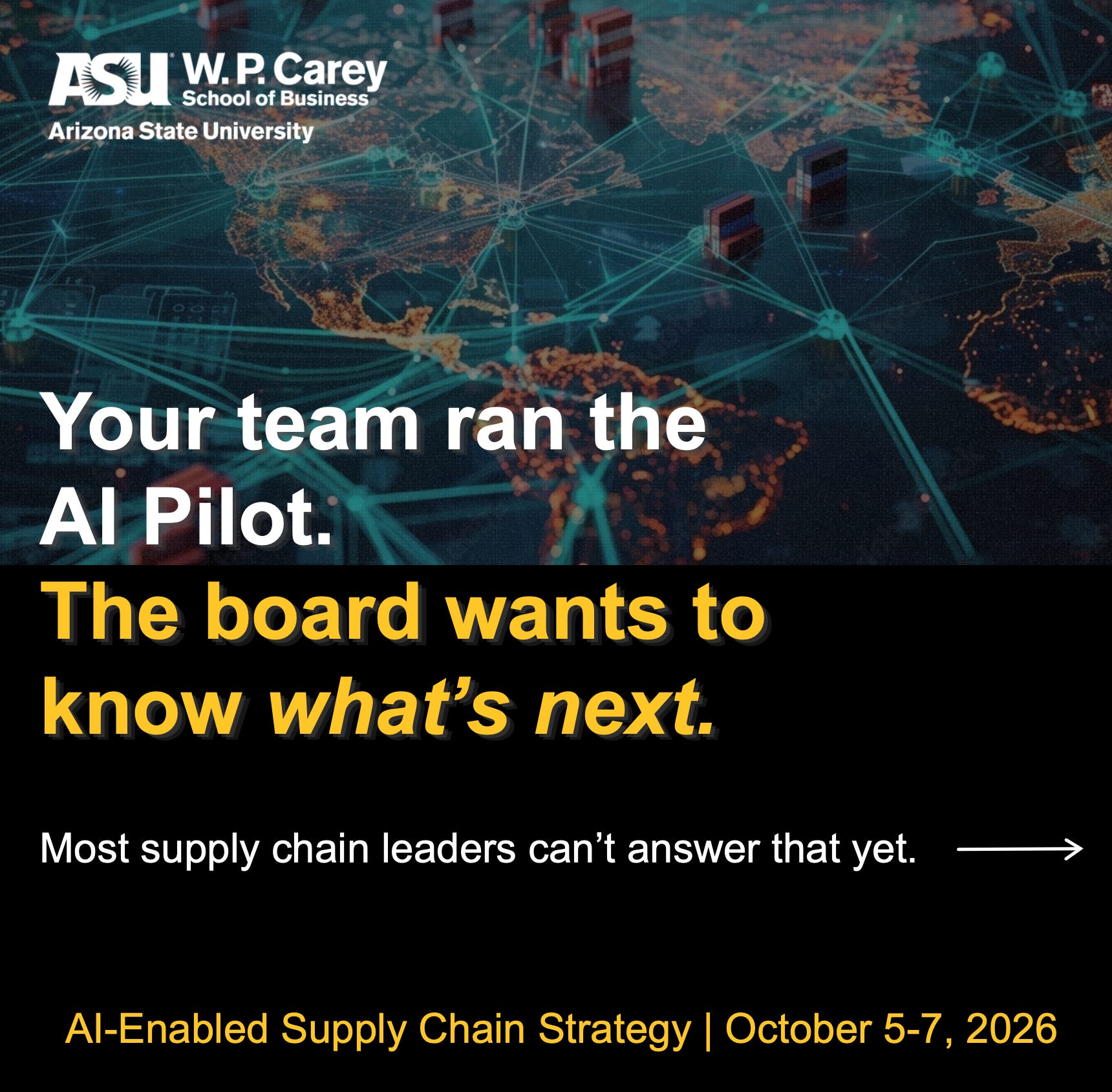
AI-Enabled Supply Chain Strategy Executive Program
3 Days. 6 Pillars. One integrated AI operating model.
Three days with W. P. Carey #2-ranked Supply Chain Management department faculty and industry leaders on capital allocation, risk governance, and where AI actually creates supply chain value — built for the executives who own the outcome.
WHO THIS IS FOR:
Chief Supply Chain Officers
Chief Operating Officers
Chief Procurement Officers
Chief Logistics or Distribution Officers
General Managers and transformation leaders
Senior executives responsible for capital strategy and risk oversight
Join peers for an executive program designed for you.
Register today at https://specialevents.asu.edu/878064 with ID Code retailrazorasu for $1,500 off the registration fee.
The same two answers, every time.
Brett’s team has spent considerable time asking supply chain leaders where the gap comes from, and he says the answers come back nearly identical.
The first is infrastructure. Siloed systems, uneven data quality, fragmentation, and AI, in his phrasing, “slapped on the legacy systems.” When that’s the arrangement, nobody can see the supply chain end to end.
An AI that can only see one department produces departmental results, which is a fine description of a pilot.
The second is adoption. Whether employees pick the tools up and use them. Zero technology in that answer.
What struck me is how unglamorous both issues are. Neither one is about picking the right AI model.
What a procurement agent does while you’re in a meeting.
Brett describes agents as a digital workforce. They plan, reason, act, and learn, and they pull data across systems without being walked through it.
In procurement that splits two ways. Tactical work is supplier identification, purchase orders, supplier performance tracking. Strategic work is spend analytics, category management, contract management, supplier risk. An agent can take runs at both.
The specifics are what makes all the difference in enterprise-wide gains.
A tariff gets imposed on a particular country, and the agent shows what that does to your pricing. It reads structured and unstructured data together, so news coverage becomes an input rather than something a person happens to catch. It runs sentiment analysis on that coverage, which matters because a supplier’s trouble shows up in the press well before it shows up in your ERP.
And it automates the supplier back-and-forth that currently means opening an email client, opening the ERP, and copying between the two.
That last one sounds small. It’s most of somebody’s Tuesday.
I’d point the first agent at your contracts.
If someone gave me one agent and asked where to aim it in procurement processes, I’d aim it at the contract portfolio, and it wouldn’t be close.
Look at what a contract manager does in a week. Reads contracts. Pulls terms and conditions. Extracts performance obligations. Watches for risk. Notifies suppliers. Updates documents. Almost all of it is reading and comparing, and the cost of missing one thing is real money.
Brett’s contract agent does the reading.
It finds contracts that have expired or come up for renewal.
It compares the terms you signed against actual purchase orders and sales data to find where on-time delivery, lead time, or quality drifted out of the agreement.
Then it sets up the supplier conversation with the evidence assembled: here’s what we agreed, here’s what happened, let’s talk about the renewal.
On the risk side it’s Kraljic matrix segmentation and supplier scorecards, maintained continuously instead of rebuilt every quarter by whoever drew the short straw.
In my days at Microsoft leading partner marketing for retail, I worked with multiple partners that delivered entire solutions built around these capabilities. ASU's executive program can show you how to build your own agent to do the job.
SPONSOR: RetailClub

RetailClub AI Festival, September 22 - 24, 2026
The Retail Razor Podcast Network is partnering with RetailClub!
There’s still time to join us at RetailClub AI Festival. From the founders of Shoptalk and Groceryshop, RetailClub AI Festival brings together 2,000 industry leaders from September 22 to 24 for three days fully outdoors in Huntington Beach focused entirely on how AI is transforming retail.
Hear from 150 leaders shaping how AI is being used across the industry, explore the technologies changing how retail works, and connect with senior leaders from across retail, brands, technology and investment.
Late registration is now available at retailclub.com/retail-razor-podcast. We’ll see you in Huntington Beach!
Where I landed.
I came into this recording expecting a conversation about models and left thinking about ownership.
The constraint is organizational. Companies with the budget to buy anything they want are stuck in the same place, which points at three questions:
who owns the AI supply chain strategy,
what it’s worth per function, and
whether the data can support an end-to-end view at all.
You can ask all three in a meeting on Monday without a vendor in the room.
The part of ASU’s program I like best because it’s the most practical is that executives build the agents themselves.
Day one procurement,
day two forecasting and inventory,
day three logistics.
Then they simulate a disruption and the agents have to work it out between them.
Brett’s reasoning is that an executive who has built one asks their team better questions afterward.
I think he’s right, and I think that’s a more useful outcome than another slide about AI maturity.
He also talks about what makes a supply chain org a “frontier firm,” which you may have heard every LLM vendor talking about lately. His definition of it at [00:12:16] is the part of the episode I’d rewind.
Listen or watch, then come back for part 2.
🎙️The Retail Razor: Data Blades, Season 2 Episode 13: “Every AI Supply Chain Strategy Ran a Pilot. Under 1% Got Enterprise Impact.”
Part 1 is live now: procurement, supplier risk, and contract intelligence with Brett Duarte. Subscribe so parts 2 and 3 land in your inbox!


Your turn.
If you’re in procurement, tell me which of your contracts an agent would flag first. I’m curious whether it’s the ones you’d expect.
If you want the full 3-day version, ASU runs the AI-Enabled Supply Chain Strategy program October 5 to 7 in Tempe. Registration is available here, and for Retail Razor listeners ID code retailrazorasu takes $1,500 off the registration cost.
Part 2 goes downstream into operations: forecasting, inventory, and the gap between a model that predicts well and a business that acts on it. If procurement is where you decide what to buy, operations is where you find out whether you got it right.
Comment on this newsletter in Substack or join the conversation on LinkedIn.
Stay sharp. Be data-driven. Harness AI.
Sincerely,
Ricardo Belmar
The Retail Razor: Data Blades
Thank You for Your Support!
We’re honored to be the #1 Indie Podcast Network for Retail on Goodpods with our shows regularly in the Top 5 of the weekly & monthly Management podcast charts. Plus, the #1 podcast in the weekly & monthly Indie Marketing and Indie Careers podcast charts.
We’re also excited to have two podcasts ranking in the Top 20 Retail Management podcasts and a Top 3 Retail Careers podcast on Apple Podcasts!
We’d love your support to help us stay at the top with all our shows by giving us a five-star rating and review on Apple Podcasts, Goodpods, or Spotify.
Data Blades is part of the Retail Razor Podcast Network, alongside The Retail Razor Show, Retail Transformers, and Blade to Greatness. Find us at RetailRazor on LinkedIn, Bluesky, Threads, and Instagram. For a full transcript of this episode, visit our retailrazor.com website!