


The Retail Razor: Data Blades podcast cuts through the noise, turning complex retail research into actionable insights for AI-first strategies that optimize customer experiences and business operations.Stay Sharp. Be Data-Driven. Harness AI!
Missed the last issue?
Boston Consulting Group looked at AI leaders in the last year and found 2x revenue growth on specific projects, with 40 to 50% cost reduction alongside it. McKinsey, later that same year, looked at organizations that had already adopted AI and found under 1% seeing enterprise-wide impact. The pilots work. Yet, somehow, the enterprise stays exactly where it was.
Is it still pretend functionality?
Casey spent years in the ERP and supply chain tech world, and she has a name for how capacity planning felt in those systems: “pretend functionality.”
I laughed when she said it on air. Then I winced, because I’ve sat through enough demos to know exactly what she means. The screen exists. The button exists. And the planner still exports everything to a spreadsheet to get a number they trust.
Forecasting, she said, was always the dream. Run scenarios, see what’s coming, act before the shelf goes empty. Most teams never got there.
So that’s the lens I brought to the latest Data Blades conversation with Professor Brett Duarte of Arizona State University’s W. P. Carey School of Business. Brett is a clinical associate professor in ASU’s NASPO Department of Supply Chain Management and teaches in its AI-Enabled Supply Chain Strategy Executive Program. Casey put it plainly at the top of the show: operations is where AI gets interesting and also where it gets oversold. We asked Brett to be specific.
Here’s my scorecard.
SPONSOR: ASU W.P. Carey School of Business
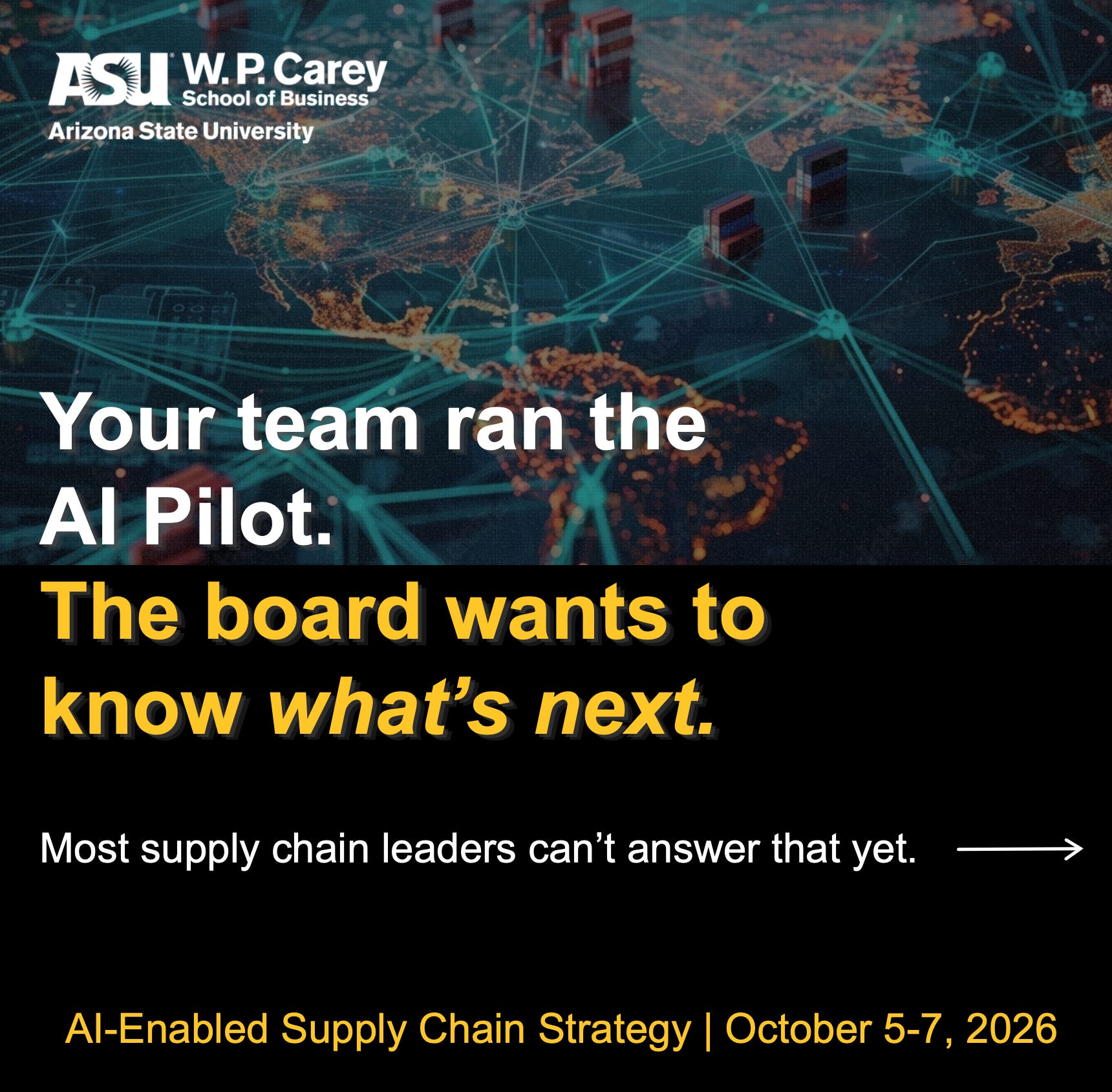
AI-Enabled Supply Chain Strategy Executive Program
3 Days. 6 Pillars. One integrated AI operating model.
Three days with W. P. Carey #2-ranked Supply Chain Management department faculty and industry leaders on capital allocation, risk governance, and where AI actually creates supply chain value — built for the executives who own the outcome.
WHO THIS IS FOR:
Chief Supply Chain Officers
Chief Operating Officers
Chief Procurement Officers
Chief Logistics or Distribution Officers
General Managers and transformation leaders
Senior executives responsible for capital strategy and risk oversight
Join peers for an executive program designed for you.
Register today at https://specialevents.asu.edu/878064 with ID Code retailrazorasu for $1,500 off the registration fee.
Real: the timing finally works.
Casey and I have heard “AI will fix forecasting” many times, so we asked what’s different now. Brett’s answer was refreshingly boring, which is why I believe it.
Four things showed up at once:
a huge amount of data,
real-time access to it,
computation that’s much cheaper than it used to be, and
models that have matured.
The part that got me was about waiting. Forecasting teams used to hold off for a window of data, sometimes six months of it, before they’d trust a new model. Brett’s point is that agentic workflows can feed information in as it arrives. As we all know, six months is an eternity in retail, especially in apparel.
A trend can come and go in that time, and you’d still be waiting on the data to prove it existed.
Real: a forecast that reads more than sales history.
Brett calls the new top layer of AI demand forecasting a reasoning layer. Statistical models and machine learning do the math underneath. A large language model sits above them and does what he called narrative synthesis and multi-source fusion.
Translation: the forecast can take a news story about consumer sentiment, a CPI release, or inflation data and fold it into the number. Planners already read that stuff. They just had nowhere to put it except a gut feel and a comment cell.
The other change is who gets to run the thing. ASU used to teach forecasting students Python syntax. Brett says they’ve stopped, because the model now asks which method you want and writes the code. I love that for managers.
I also think it means a lot more forecasts are about to get generated by people who can’t tell a good one from a bad one, which is why Brett’s program spends its time on comparing methods and judging prediction quality.
Needs proof in your own shop: the 35%.
Brett pointed to Amazon reporting a 35% reduction in stockouts from its AI inventory tools. I love a number like that. I also know your business is not Amazon (well, except for those of you reading this who work at Amazon, naturally 🙄).
Treat it as proof the direction is right. Your own pilot sets the target.
What made inventory optimization feel real to me was the workflow. An agent senses a demand spike and raises a purchase order. While it builds the order, it checks the supplier contract for budget limits and terms. Routine orders go out on their own. Important ones land in front of a human.
Brett also walked through two more company examples at 12:00, and they’re worth hearing in his words. I’m not going to spoil them here.
SPONSOR: RetailClub
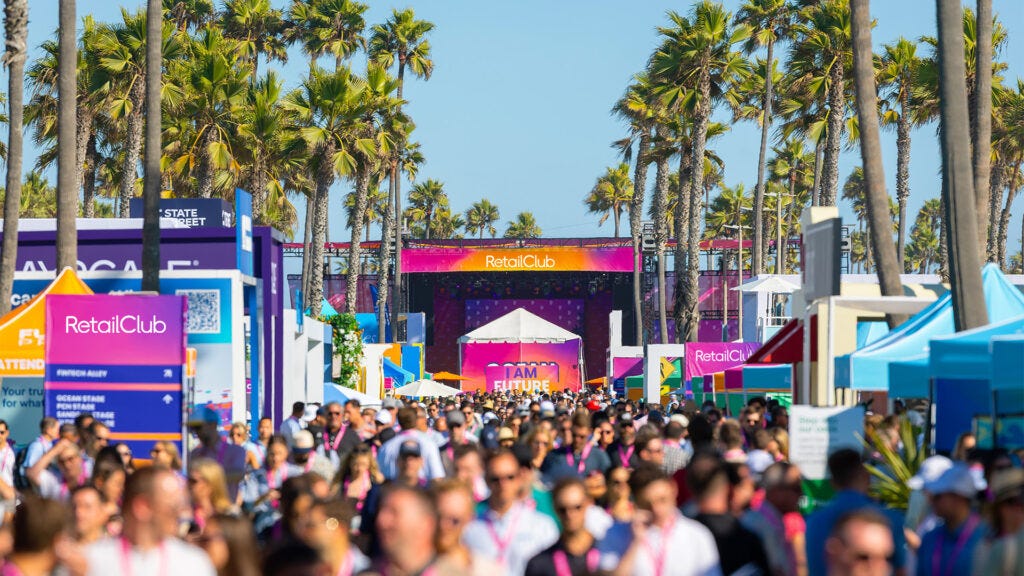
RetailClub AI Festival, September 22 - 24, 2026
The Retail Razor Podcast Network is partnering with RetailClub!
We hope you’re joining us at RetailClub AI Festival. From the founders of Shoptalk and Groceryshop, RetailClub AI Festival brings together 2,000 industry leaders from September 22 to 24 for three days fully outdoors in Huntington Beach focused entirely on how AI is transforming retail.
The Retail Razor Podcast Network will be in booth #430 - come visit us! We’ll be recording podcasts with retailers at the event and may have a special guest with us that you don’t want to miss! Check out everything happening at RetailClub AI Festival here for last minute registration: retailclub.com/retail-razor-podcast.
We’ll see you in Huntington Beach!
Where I landed.
I walked in hopeful and walked out with a pretty specific opinion. The AI promise in operations is real where it shortens the time between a demand signal and a purchase order.
It’s oversold anywhere it adds a new dashboard that planners export to a spreadsheet anyway. Casey already has a name for that.
If I ran a retail supply chain team tomorrow, I’d do two things before buying anything. I’d write down which orders an agent can send without asking and which ones need a person. And I’d make sure the people approving forecasts can compare them on accuracy instead of trusting whichever one came with the nicest chart.
I’ll also admit something. When Brett described the inventory day of ASU’s program, I wanted a seat. It’s absolutely worth it.
Watch, listen, and come back next episode.
🎙️The Retail Razor: Data Blades, Season 2 Episode 14: “35% Fewer Stockouts: What AI Demand Forecasting Changes in Supply Chain Operations”
The full conversation is 16 minutes on Data Blades. Brett’s take on where your safety stock should sit starts at 13:10, and it’s the part I’d send to your CFO. Part 2 is live now! Subscribe so you don’t miss Part 3!


Your turn.
If this landed in your inbox from a friend, subscribe so you get Part 3.
If you want the full 3-day version, ASU runs the AI-Enabled Supply Chain Strategy program October 5 to 7 in Tempe. Registration is available here, and for Retail Razor listeners ID code retailrazorasu takes $1,500 off the registration cost.
Next episode is Part 3: logistics. Routing, network design, control towers, last mile, and what AI can do when a shipment goes sideways. Then we get into the governance and ROI case every executive wants before anything gets funded. Casey’s puppy Ruffles has promised to nap through that one after stealing a folder during this recording. 🐶🐾🦮
Comment on this newsletter in Substack or join the conversation on LinkedIn.
Stay sharp. Be data-driven. Harness AI.
Sincerely,
Ricardo Belmar
The Retail Razor: Data Blades
The Retail Razor Is In The Field!
We’re on the road for the final two weeks of September!
You’ll find us recording podcast interviews in the Retail Razor beachside recording studio at RetailClub AI Festival from Sept 22-24!
Then you’ll find us in the RETHINK Retail Creator Studio at Shoptalk FALL from Sept 29 - Oct 1!
If you’re at either event, be sure and reach out to us!
We’d love your support to help us stay at the top of the charts with all our shows by giving us a five-star rating and review on Apple Podcasts, Goodpods, or Spotify.
Data Blades is part of the Retail Razor Podcast Network, alongside The Retail Razor Show, Retail Transformers, and Blade to Greatness. Find us at RetailRazor on LinkedIn, Bluesky, Threads, and Instagram. For a full transcript of this episode, visit our retailrazor.com website!