


Retail Transformers brings you candid conversations with the people reshaping the future of commerce - the crazy ones, the rebels, the change makers, innovators, disruptors, and bold thinkers. Stay Sharp. Be Bold. Transform Retail!
Missed the last issue?
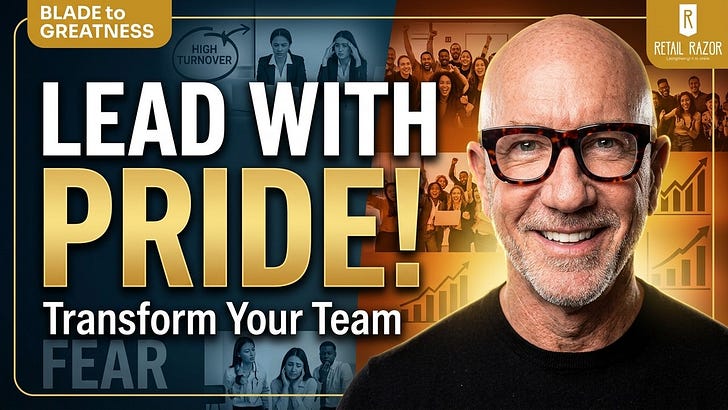
If you’ve ever led a retail team, you’ve probably had that moment where you stare at the schedule, the KPIs, or the attendance log and think, “What is happening here?”The classic assumption is that you’re dealing with a performance issue. Or a staffing issue. Or a motivation issue. Or maybe Mercury is in retrograde and the universe is personally targeting your store. But according to Ron Thurston, the real issue is usually much simpler. And much more uncomfortable. You don’t have a performance problem. You have a pride problem.
Agentic Commerce, Product Catalog Optimization, and Why You’re Already in Keyword Jail
Here is a sentence that will either motivate you or ruin your afternoon, depending on how you feel about your product data.
Your catalog probably has five or six attributes per product. Maybe a few more if someone on your team was feeling ambitious. And for the last 20 years, that was fine. Google only gave you four words of shopper intent anyway, so there was no real pressure to say more.
That era is over.
AI shopping agents do not work like Google. They do not skim your homepage or get distracted by a banner ad. They query your product data directly, match it against what a shopper actually wants (in full, rich, conversational detail), and then buy from whoever has the best match. If your data is thin, they move on. Fast. Without a word.
Scot Wingo has a name for where we have been living. He calls it keyword jail. And the bad news is that most brands do not even know they are locked in it.
SPONSOR: RetailClub

RetailClub AI Festival, September 22 - 24, 2026
The Retail Razor Podcast Network is partnering with RetailClub!
Join 2,000 retail leaders at the RetailClub AI Festival, September 22–24 in Huntington Beach. Dive deep into how AI is reshaping retail while soaking up the sun at a fully outdoor, beachside venue. Decision-makers from retailers and brands can attend with free tickets and up to $1,250 in travel reimbursement.
Head to retailclub.com to learn more and get your ticket today!
Who Is Scot Wingo and Why Should You Listen to Him
If you have been in e-commerce for more than five minutes, you probably already know the answer to this. Scot founded ChannelAdvisor in 2001, at a time when eBay was still fighting over whether to add a buy button (seriously, there was community outrage and we talk about it on the podcast). He built the company into the dominant platform for helping retailers sell across online marketplaces, took it public in 2013, and eventually sold it to private equity in 2022. It is now rebranded as Rithum (they joined us in this podcast episode last year to review Amazon Prime Day results) and does something in the range of $300 to $400 million in annual recurring revenue.
He also co-hosts The Jason and Scot Show podcast, which is about as close to an OG retail podcast as you can get without having been there in person. Odds are, if you’re reading this newsletter, you listen to The Jason and Scot Show.
Now he’s also the host of another podcast, Retailgentic, and writes a companion newsletter, focusing squarely on all things agentic commerce and agentic AI. Oh, and if that’s not enough, he’s also the CEO (er, Agentic CEO) of ReFiBuy, a company he built specifically around one idea:
agentic commerce is going to compress the entire shopping journey, and the infrastructure to support that does not really exist yet.
When someone who called the Amazon marketplace wave in 2001 says something big is coming, the reasonable move is probably to stop scrolling and listen.
Scot joined us on the latest Retail Transformers podcast where we tried very hard to contain ourselves to just a on hour discussion on his e-commerce history and where he’s going now in agentic commerce.
So What Actually Is Agentic Commerce
There is a lot of buzzword fog around this term right now, so let us clear some of it. For a simple version of the basics, you could go back and listen to or watch this episode of The Retail Razor Show where Mike Edmonds from PayPal joined us as covered in this newsletter issue.
The even simpler version: agentic commerce is what happens when an AI agent shops on your behalf. Not just recommends. Not just filters. Actually completes the transaction. You tell it what you want, set some parameters, and it handles the Research, Find, and Buy journey for you.
Scot named his company ReFiBuy as a nod to exactly that compression. Research. Find. Buy. Three steps that used to take hours of browsing, comparing, and second-guessing, collapsed into a single conversation with an AI agent.
Now, not every purchase works this way. Scot is pretty clear about that. There is a spectrum. And it’s easy to get lost in the definitions of this (see the previously mentioned episode and newsletter issue).
On one end, you have essential goods. Toilet paper. Your usual coffee. The same dog treats you order every month. These are autopilot purchases. You would happily hand those over to an agent completely and never think about it again.
On the other end, you have highly personal purchases. Casey’s famously elusive pencil skirt with a double kick pleat, for example. You want help finding it, but you are absolutely reviewing it yourself before anything in a cart is checked out and paid for. No agent is buying that unsupervised. (Just ask Casey!)
The interesting territory is everything in between, and that middle ground is much larger than most people assume.
The Catalog Wake-Up Call
Here is where the conversation gets uncomfortable for a lot of retailers.
Scot walked us through what happened at ChannelAdvisor during the Amazon marketplace era. Matching a seller’s product to Amazon’s catalog was genuinely hard. Amazon had this master catalog, and you had to map your product to exactly the right SKU. But the data was always incomplete. You would have a Nike jacket in size large, and Amazon would say, great, we have 30 possible SKUs for that, pick one. Except you did not have the granular detail needed to make the call. Is the zipper gold or silver? What is the cuff style?
So humans did it.
At peak, ChannelAdvisor had 500 people in Bulgaria working in shifts, 24 hours a day, doing this mapping manually.
It was expensive. The quality was never where it needed to be. And it was the kind of problem that nobody had a good answer to.
Then Scot started reading Anthropic’s white papers on agentic frameworks. Within 90 days, his team had a prototype that could solve the mapping problem without any human involvement at all.
Five hundred people. Ninety days. Gone.
That is not a cautionary tale. That is actually a preview of what AI agents are going to do to the entire product discovery process. And it means that the data quality problem, which was always a background annoyance, is suddenly front and center.
Because if your catalog only tells an AI agent five things about your product, and your competitor’s catalog tells it fifty, the agent is not going to flip a coin.
Keyword Jail: A Brief History of Being Trapped
The reason most catalogs are so thin is not laziness. It’s conditioning.
Google’s search model gave retailers roughly four words of shopper intent per query. That was it. So merchants learned to optimize for that ceiling. Five or six attributes per product was plenty. More than that, and you started creating problems for your own filtering and faceted navigation.
There was also a perverse incentive at work.
The more attributes you added, the more edge cases you created. What if someone filters for a feature your product technically has but the naming does not match? Suddenly you are generating zero results pages and hurting conversion. So everyone kept their catalogs lean.
The AI era flips this completely.
A shopper using an AI agent does not type four keywords. They describe what they want in full sentences, with context, with preferences, with occasions in mind. The shopper intent that these systems have access to is enormous.
And your five-attribute catalog is standing in a corner looking very small.
Scot describes the fix as three layers. More attributes, obviously. But also making sure AI engines are consuming your customer reviews, because reviews are full of the contextual, conversational product information that catalogs miss. And then there is a third layer that most brands have not even heard of yet: a Q&A section in your product data that lets you create an essentially infinite amount of contextual information about each product.
Think about it like this:
What would a really good sales associate at Sephora tell a customer who walked up to the lip display?
What are the three questions they ask?
What are the answers?
That is the kind of content that needs to live in your product data now. Not because shoppers are reading it. Because AI agents are.

Who Is Actually Doing This Well
Beauty and fashion are leading the pack right now, which makes sense. Those categories have the most to gain from better product discovery, and their customers are already experimenting with AI shopping tools.
At ShopTalk, Scot flagged Sephora and Ulta as ones to watch. They are always in a battle with each other, and both are leaning into agentic commerce early. Gap announced plans to tie directly into Google’s Universal Checkout Protocol. e.l.f. Brands showed up as a forward-thinking name in the conversation as well.
Google’s UCP is worth paying attention to separately.
They announced it in January, launched it in February, and Scot’s prediction when we recorded was that live examples with major loyalty programs would follow quickly after. The piece that is particularly interesting is something called identity linking, which we get into in detail in the episode. The short version is that it starts to solve a problem that has plagued third-party selling for decades:
How does a brand actually retain a relationship with a customer who bought through a marketplace?
That conversation alone is worth the listen time.
The Part Where We Stop Giving It All Away
There is a lot more in this episode. A. Lot. More.
Scot goes deep on the OpenAI Instant Checkout experiment, what it got right (the merchant of record innovation was genuinely significant), and what it missed (multicart support, loyalty integration, and being staffed by more than ten people for something that immediately overwhelmed demand).
He also breaks down his prediction for the next holiday season in a way that is either exciting or alarming depending on your current relationship with your product catalog.
And he covers the internal change management conversation that most retailers are going to have to have with their legal teams before any of this can move forward.
That last part is funnier than it sounds, in a dark, relatable way.
What To Take Away From This
Whether you buy the big holiday shopping prediction or not (yes, listen/watch to find out!), the underlying shift is real. AI agents are already being used to research and discover products.
The brands that take product catalog optimization seriously now are building an advantage that will be very hard to close later. The ones that wait are going to find themselves in a familiar position, playing catch-up on a wave that moved faster than they expected.
Scot has seen this movie before. He was in the room when everyone said Amazon could not figure out fashion and the returns would kill them.
He was not one of the ones saying it.
Listen to the Full Episode
Retail Transformers, Season 2, Episode 4: The Agentic Commerce Playbook: Scot Wingo on AI Shopping, Catalog Optimization, and the Future of Retail
Available on Goodpods, Spotify, Apple Podcasts, YouTube, and everywhere you listen.

Your Turn
If someone forwarded this to you and you want more like it, hit the subscribe button. We cover the ideas, the people, and the moves reshaping retail, without the fluff.
Comment on this newsletter or join the conversation on LinkedIn! Your insights may help shape the topics we explore next.
Until next time! Stay sharp. Be Bold. And Transform Retail!
Sincerely,
Ricardo Belmar & Casey Golden
Co-hosts of The Retail Razor Show
Thank You for Your Support!
We’re honored to be the #1 Indie Podcast Network for Retail on Goodpods with
the top 4 podcasts in the Top Weekly Management Podcast charts
the top 4 podcasts in the Top Monthly Management Podcast charts
the #1 podcast in the Top Weekly & Monthly Indie Careers Podcast charts
the #1 podcast in the Top Weekly & Monthly Indie Marketing Podcast charts
And we’re excited to have two podcasts ranking in the Top 20 Retail Management podcasts and a Top 5 Retail Careers podcast on Apple Podcasts!
We’d love your support to help us stay at the top with all our shows by giving us a five-star rating and review on Apple Podcasts, Goodpods, or Spotify.
The Retail Razor Podcast Network
The Retail Razor:Retail Transformers show is part of The Retail Razor Podcast Network along with our other core shows:
Please leave us feedback by posting your comments to Notes on Substack, Apple Podcasts, Spotify, YouTube, or Goodpods.
Connect with us on LinkedIn.
Subscribe & watch on YouTube.
Follow us on Instagram, Threads, Bluesky, and Facebook.
For a full transcript of this episode, visit our Retail Razor Podcast Network website!