


Retail Transformers brings you candid conversations with the people reshaping the future of commerce - the crazy ones, the rebels, the change makers, innovators, disruptors, and bold thinkers. Stay Sharp. Be Bold. Transform Retail!
Missed the last issue?
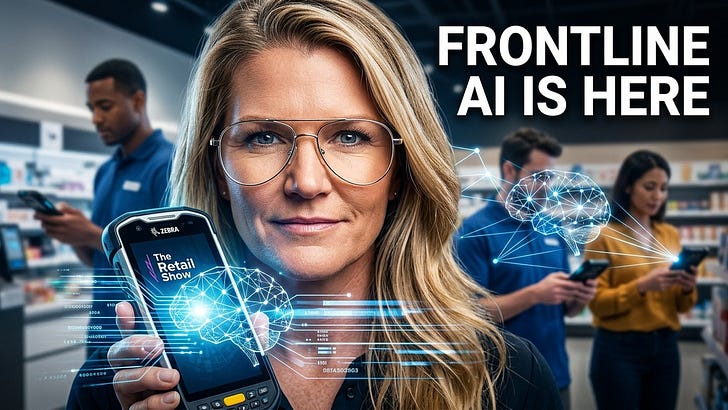
There’s a store associate holding a handheld with 80 apps loaded on it. They use about a dozen. The rest are digital clutter that somebody back in corporate was sure they needed. That image is the cleanest way to explain what Zebra Technologies ZONE 2026 Customer Conference was about.
Your AI Told You to Stock Winter Coats. In Miami.
Picture a brand new, very expensive AI system looking at a store in Miami and confidently deciding the smart move is to load it up with winter coats. Not a glitch. The thing worked exactly as designed. It just got fed data so messy it couldn’t tell “available in navy” from “available in blue,” so it did the math and ordered parkas for people who own three pairs of flip flops and nothing else.
That story has been living rent free in my head since we hit stop on this episode.
Casey and I just sat down with Julie Averill for the latest Retail Transformers podcast, and I will be honest, our shared notes doc was the longest we have ever built going into a recording. Julie spent a decade at Nordstrom, ran technology at REI, then spent seven years as the Global CIO of Lululemon while it went from $2 billion to over $10 billion. She has a new book out called Chief Impact Officer, and the subtitle does the heavy lifting on what she believes: real transformation comes from human, not just artificial, intelligence.
If you only take one thing from this episode, take this thought from Julie.
AI doesn’t fix your culture. It reveals it.
SPONSOR: RetailClub

RetailClub AI Festival, September 22 - 24, 2026
The Retail Razor Podcast Network is partnering with RetailClub!
Join 2,000 retail leaders at the RetailClub AI Festival, September 22–24 in Huntington Beach. Dive deep into how AI is reshaping retail while soaking up the sun at a fully outdoor, beachside venue. Decision-makers from retailers and brands can attend with free tickets and up to $1,250 in travel reimbursement.
Head to retailclub.com/retail-razor-podcast and get your ticket today!
Why 95% of AI projects fail, in one sentence.
You’ve seen the stat by now. Something like 95% of AI pilots never make it out of the lab. The lazy read is that the technology is not ready. Julie’s read, and I think she is dead right, is that we keep bolting AI onto broken processes, half-built data, and decision rights nobody can actually name. The AI then does its job perfectly and hands you a perfectly confident wrong answer. Winter coats. Miami.
This is the part that should make a few executives squirm.
The reason why AI projects fail is rarely sitting in the model. It’s sitting in the org chart, the spreadsheet someone has been quietly maintaining for five years, and the foundation everyone agreed to deal with “later.”
AI just moved the deadline on later to right now.
The data foundation nobody wants to fund.
Julie does something in this conversation that I wish more leaders would do. She admits she kept putting off building a unified data foundation, year after year, because there was always something flashier to ship. Then AI showed up and made the bill come due.
Here is what makes it hard, and why your favorite vendor will not solve it for you.
A real data foundation is not a technology problem. It’s a business process problem wearing a technology costume. The attribution starts in merchandising, runs through customer experience, and ends up in supply chain, and everybody along the way has been adding their own little fields and quirks. Until someone with authority stands up and says this is not what we build on, you cannot fix it. You can only keep piling more AI on top and hoping.
Of course, this is the part where I remind you that hope is not a strategy.
Julie also said the quiet thing out loud about real-time data. It used to be a competitive advantage. Going into 2027, it’s just the price of admission. If your competitor is changing prices by the minute and you’re running a weekly spreadsheet that one person uploads on Monday, you’ve already missed the market 57 times before lunch. Ok, I’m paraphrasing, but only barely.
The catcher’s crouch, and the best business advice hiding in a baseball glove.
Quick detour that turned into one of my favorite parts.
Julie comes from a baseball family. Her grandfather is in the Hall of Fame, her dad played for the better part of a decade behind the plate, and she talks about leading from the catcher’s crouch. Low, wide, ready, and the only player on the field looking out at everything instead of in at the ball.
She calls it systems thinking, and once she said it I couldn’t unsee it.
The catcher reads every hitter’s tendencies, knows how people behave under pressure, and sees the whole field as a set of parts that have to work together. That’s the job when you’re running technology for a company growing in every direction at once. You’re not staring at the pitch. You’re watching the entire game.
Selling the upside and skipping the cost.
This one got Julie on her soapbox, in the best way. She drew a straight line from return to office to AI, and it’s uncomfortable because it’s true.
When companies pushed everyone back to the office, leaders sold the upside. Culture, collaboration, the water cooler magic.
What they skipped was the cost people were quietly absorbing, like the after-school pickup that no longer worked or the parent at home who now needed other care. Julie owns that she did exactly this. And the result was predictable. People are smart. They know the truth.
When you only give them half of it, they decide you are either lying or naive, and either way you lose trust.
Now watch what is happening with AI.

Endless talk about efficiency and tools at your fingertips, and almost nobody saying the honest version: I cannot promise your job is safe, but I can promise you will be part of this and I will support you the whole way.
Worse, companies are laying off thousands and slapping an “AI efficiency” label on it to look like visionaries instead of admitting they overhired during the pandemic and are course correcting.
Julie made this point as clear as a storefront window:
If the companies laying off thousands have become so efficient from AI that they no longer need the employees, then they must have incredible revenues and strong balance sheets. Except they don’t.
The good news, and Julie called this too, is the market appears to have stopped rewarding the spin.
People are smart. They know the truth. When you only give them half of it, you lose them.
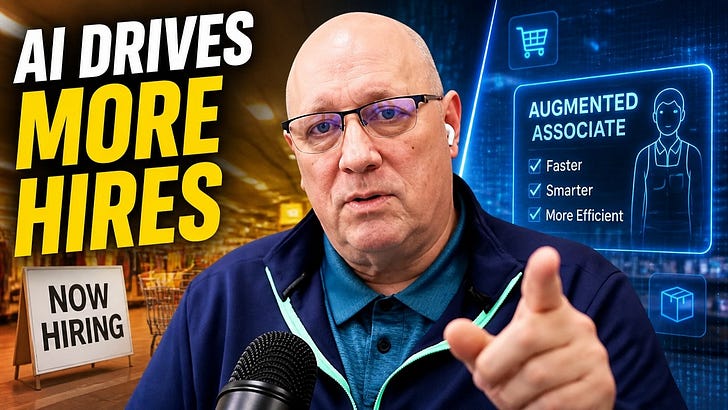
More episodes that relate to the AI reveals your culture through line:
Make yourself unnecessary.
There is a chapter in the book about the goal of leadership being to make yourself unnecessary, and it stuck with me because most executives would never say it out loud and it’s a team management philosophy I’ve held for years.
Julie got to a point at Lululemon where she looked around and realized she had climbed the hill, she had the scar tissue to prove it, and the team did not need her anymore. So she left.
Then a dream job showed up almost immediately.
Bigger company, great culture, the obvious next rung. She turned it down. Not because anything was wrong, but because taking it would have answered the safe question instead of the real one, which was: who is Julie without a logo?
If you’re somewhere between 40 and 60 and that question just landed a little too hard, you’re not alone, and this is the part of the episode you will want to sit with.
So, is the book worth it?
Yes. Next question.
And I do not say that about most business books, which tend to be one decent idea in a trench coat pretending to be 250 pages. Chief Impact Officer is honest in a way the genre almost never is. Julie tells you about the wins, sure, but she also tells you about the resignation letter she wrote in a Vancouver hotel room, the masks she wore as the only woman in the room, and the foundation she deferred for too long.
The stories are the argument.
You finish it understanding why real retail AI transformation is a people project before it’s a technology project.
I asked Julie what she would put on a billboard outside every retail tech conference, aimed straight at the vendors. She did not hesitate.
AI is not the point.
Frame that and hang it over the demo room.
🔊Go listen, then go buy the book. 📕
Retail Transformers, Season 2, Episode 6: In Retail AI Transformation, AI Doesn’t Fix Your Culture, It Reveals It
We barely scratched the surface here. The full conversation goes deeper on the Bangalore tech hub Julie built to 46% women in a market where 14% of STEM jobs go to women, the merchandising AI demo that fell apart the second a real human asked a real question, and a lot more. It is one of the best ones we have recorded this season, and I‘m not just saying that because Casey will read this.
Listen to the full episode wherever you get your podcasts, or watch it on YouTube. Then go grab Chief Impact Officer. Your data foundation will thank you.


Your Turn.
If this landed, subscribe so the next one shows up in your inbox. We do this every episode, and the guests keep being people who seriously transformed retail instead of just tweeting about it.
Comment on this newsletter or join the conversation on LinkedIn!
Your insights may help shape the topics we explore next.
Until next time! Stay sharp. Be Bold. And Transform Retail!
Sincerely,
Ricardo Belmar
The Retail Razor: Retail Transformers
Thank You for Your Support!
We’re honored to be the #1 Indie Podcast Network for Retail on Goodpods having recently hit the #1 spot on the Top Weekly & Monthly Indie Business Podcast charts, plus the:
Top 4 podcasts in the Top Weekly Management Podcast charts
Top 4 podcasts in the Top Monthly Management Podcast charts
#1 podcast in the Top Weekly & Monthly Indie Careers Podcast charts
#1 podcast in the Top Weekly & Monthly Indie Marketing Podcastcharts
And we’re excited to have two podcasts ranking in the Top 20 Retail Management podcasts and a Top 5 Retail Careers podcast on Apple Podcasts!
We’d love your support to help us stay at the top with all our shows by giving us a five-star rating and review on Apple Podcasts, Goodpods, or Spotify.
The Retail Razor Podcast Network
Retail Transformers is part of the Retail Razor Podcast Network, alongside The Retail Razor Show, Blade to Greatness, and Data Blades. Find us at RetailRazor on LinkedIn, Bluesky, Threads, and Instagram. For a full transcript of this episode, visit our retailrazor.com website!
Omg. AI is completely beside the point. Love it