


From the #1 Indie Podcast Network for Retail, The Retail Razor: Blade to Greatness retail leadership podcast explores the skills, mindset, and strategies retail executives need to lead successfully in the AI era. Stay Sharp. Lead Boldly. Stay Human.
Missed the last issue?
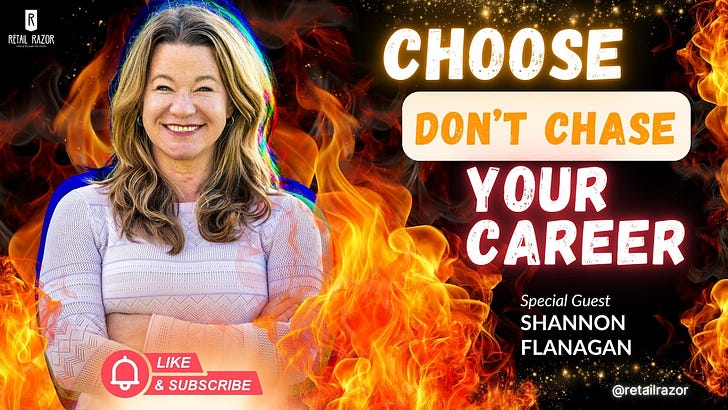
Casey went through Shannon Flanagan’s new book, got to the part about pausing, and asked herself when she last had three months where nothing was scheduled. Her answer: the summer she was 17. That’s the conversation we had with Shannon on The Retail Transformers podcast recently. Shannon founded Retail Women in Tech (RWIT) and just published Choose - don’t chase - Your Career. She wrote it in the middle of doing the thing the book describes,and it’s something none of us knew we needed for our own careers.
The accelerator mindset.
I asked Steve Worthy a question I’ve been sitting on for a long time, and I braced for a diplomatic answer.
Why do good products fail when they enter retail?
He laughed first. Then he gave me the least diplomatic answer anyone has given me on the show.
Steve is the Founder of Worthy Global Retail, and he came back to Blade to Greatness to walk Casey and me through what he calls the accelerator mindset. He spent years as a retail executive before he started coaching founders through The Forge Accelerator and The Campus, so he’s been on both sides of the meeting where a founder pitches a retailer and nothing happens afterward.
This issue, and podcast episode, is especially powerful for the founders and tech companies in the audience.
SPONSOR: ASU W.P. Carey School of Business
AI-Enabled Supply Chain Strategy Executive Program
3 Days. 6 Pillars. One integrated AI operating model.
Three days with W. P. Carey #2-ranked Supply Chain Management department faculty and industry leaders on capital allocation, risk governance, and where AI actually creates supply chain value — built for the executives who own the outcome.
WHO THIS IS FOR:
Chief Supply Chain Officers
Chief Operating Officers
Chief Procurement Officers
Chief Logistics or Distribution Officers
General Managers and transformation leaders
Senior executives responsible for capital strategy and risk oversight
Join peers for an executive program designed for you.
Register today at https://specialevents.asu.edu/878064 with ID Code retailrazorasu for $1,500 off the registration fee.
The 85% nobody wants to look at.
Steve pulled a number from Product School during the conversation. Somewhere between 80 and 85% of AI projects fail inside the companies that run them. And if you doubt Steve’s number, he’s not alone citing this. 5 different studies published in the last 18 months from Gartner, MIT, RAND Corporation, BCG, and McKinsey all point to the same conclusion: 70-85% of enterprise AI initiatives fail to deliver their expected value.
Then he compared this moment to the .com era, when a website was enough to start making money and most of those businesses didn’t last, because they hadn’t solved a real problem.
I’ve been calling this the AI hype machine for a while now. Steve credited me with the phrase on air, which I’ll take (even if I probably took it from somewhere else). But he pushed it somewhere I hadn’t:
Hype lets a founder skip problem definition and still feel like they’re winning, right up until the retailer stops replying.
Everybody says yes until yes costs money.
Casey named the moment every founder in this space has lived. You run 100 customer interviews. Everyone tells you they love it. Then you ask for $50,000 to go build it, and the room goes quiet.
Steve’s explanation is the part we’re usually afraid to say out loud.
Retailers don’t want to talk about their problems. Admitting that logistics is broken, or that the buy was wrong this year, or that training isn’t happening, puts a mistake on record and makes somebody look bad. So it stays in house.
Which means retail tech founders are selling a fix for a problem the buyer has decided nobody outside the building gets to see. As Steve put it:
“If I can’t tell you I truly have a problem, I don’t want your solution identifying the issue I don’t want anybody else to know about.”
Read that again as a founder and the silence after a good meeting starts to make sense.
SPONSOR: RetailClub

RetailClub AI Festival, September 22 - 24, 2026
The Retail Razor Podcast Network is partnering with RetailClub!
There’s still time to join us at RetailClub AI Festival. From the founders of Shoptalk and Groceryshop, RetailClub AI Festival brings together 2,000 industry leaders from September 22 to 24 for three days fully outdoors in Huntington Beach focused entirely on how AI is transforming retail.
Hear from 150 leaders shaping how AI is being used across the industry, explore the technologies changing how retail works, and connect with senior leaders from across retail, brands, technology and investment.
Late registration is now available at retailclub.com/retail-razor-podcast. We’ll see you in Huntington Beach!
The test that turns a pitch into a conversation.
Here’s the tool I’d hand every founder listening.
Steve sorts retail problems into systemic and non-systemic.
Non-systemic problems get fixed fast, usually inside one team or one store.
Systemic problems take time, cost money, and cross departments.
Retailers fund the systemic ones.
He got this test years ago from Gregg Steinhafel, then the CEO of Target, in an interview. One store with a problem is not a problem, and it’s probably a leadership question at that store. The same problem across many stores is a conversation worth having.
Casey put the other half of it perfectly. She doesn’t mind doing a VLOOKUP. It’s an annoyance at scale. Nobody funds an annoyance.
So before the next pitch: is this one store, or is this every store? If you can’t answer with evidence, you’re asking a retailer to fund your curiosity.
Where I landed.
I said on the episode that a lot of tech startups don’t speak the language a retailer wants to hear, and I’ve believed, and witnessed, that for years. What Steve did was tell us why, and it’s less flattering than a translation problem.
Founders haven’t studied the buyer the way they’ve studied the product. They lead with the product because the product is the part they know cold.
Steve starts them somewhere else entirely, with founder fit:
why are you in retail at all, and what’s the story that connects you to it?
Retail buyers listen for that before they hear a word about features, because they’re deciding whether you understand their world.
When a founder can’t answer, he runs the five whys with them. He joked about the grad school money he paid to learn it. He also said some founders come out of that exercise deciding to pivot, which tells you how far off the original answer usually was.
Two things I’m leaving on the podcast. Around 13:53, Casey and I get into what this AI moment is repeating from an earlier era of retail tech, and Steve’s reaction is worth hearing unedited. And around the 10-minute mark, Steve says out loud why he left the retail executive ranks. It’s the most candid 15 seconds in the episode and I’m not going to spoil it here.
Listen to the full conversation.
🎙️Blade to Greatness, Season 2 Episode 12: The Accelerator Mindset - What Retail Tech Founders Get Wrong
The complete episode is available now everywhere you find podcasts. If you get something out of these, subscribe so the next one shows up in your inbox.


Your Turn.
Subscribe now and you get the best of each episode in your inbox before you have time to listen. If this one was useful, forward it to the leader on your team who is still reading the to-do list out loud every morning instead of asking a coaching question.
Comment on this newsletter or join the conversation on LinkedIn! Your insights can help shape the topics we explore next!
Until next time… Stay sharp. Lead boldly. Stay human.
Sincerely,
Ricardo Belmar
The Retail Razor: Blade to Greatness
Thank You for Your Support!
We’re honored to be the #1 Indie Podcast Network for Retail on Goodpods with our shows regularly in the Top 5 of the weekly & monthly Management podcast charts. Plus, the #1 podcast in the weekly & monthly Indie Marketing and Indie Careers podcast charts.
We’re also excited to have two podcasts ranking in the Top 20 Retail Management podcasts and a Top 3 Retail Careers podcast on Apple Podcasts!
We’d love your support to help us stay at the top with all our shows by giving us a five-star rating and review on Apple Podcasts, Goodpods, or Spotify.
Blade to Greatness is part of the Retail Razor Podcast Network, alongside The Retail Razor Show, Retail Transformers, and Data Blades. Find us at RetailRazor on LinkedIn, Bluesky, Threads, and Instagram. For a full transcript of this episode, visit our retailrazor.com website!